Koenji
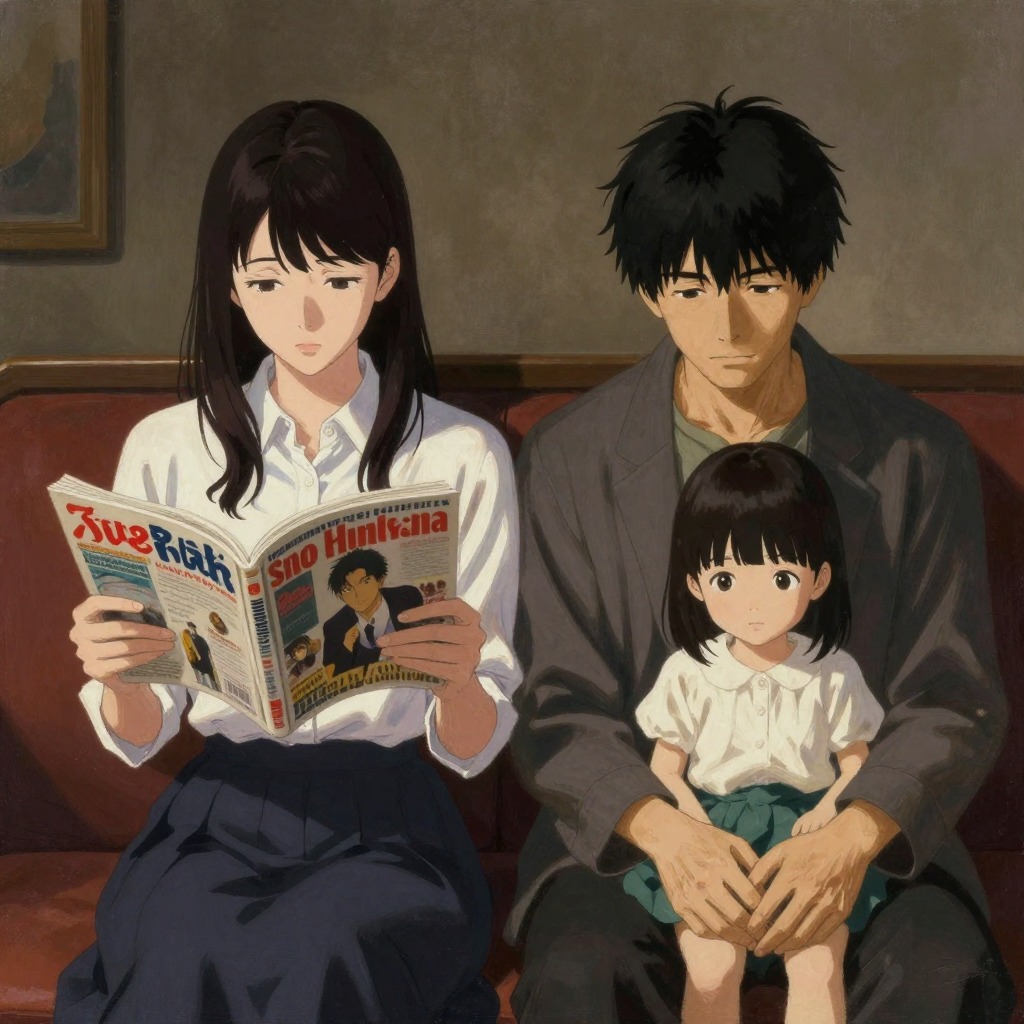
Koenji, a residential district in western Tokyo, becomes the setting for the most stable domestic interlude in Yozo's adult life. After running away from Flatfish's house in Okubo, Yozo is taken in by Shizuko, a magazine journalist, and moves into her apartment in Koenji. The apartment is modest, located in a building where the superintendent's room serves as a daytime refuge for Shigeko, Shizuko's five-year-old daughter, before Yozo's arrival. Here Yozo leads for the first time the life of a kept man, supported by Shizuko's salary and the income from the children's magazine cartoons she helps him publish. The apartment window looks out on a kite caught in telegraph wires, torn by the dusty spring wind but clinging tenaciously—an image that haunts Yozo's dreams and makes him smile with embarrassment and blush. This period marks a rare pause in Yozo's downward spiral, yet it is shadowed by his persistent gloom, his craving for liquor, and his sense of being trapped in a dependency he cannot break.
Domestic Routine and the Role of Shigeko
Inside the Koenji apartment, Yozo's days take on a repetitive shape. While Shizuko works at the magazine publisher's office, Yozo stays home with Shigeko, who quickly begins calling him "Daddy" without hesitation. He draws cartoons for her, and she becomes his one slight relief from depression. When Shizuko returns from work, Yozo dashes out as if in relay with her, heading to the outdoor booths near Koenji Station to drink cheap, strong liquor. The apartment is also the site of a painful exchange when Shigeko asks whether God grants prayers: Yozo tells her that he has no chance because he disobeyed his father, and Shigeko replies that everyone says he is so nice—a remark that forces Yozo to recognize how thoroughly he deceives those around him. When Shigeko later says she would ask God for her real father back, Yozo feels dizzy with shock, suddenly seeing the child as an enemy, an incomprehensible stranger full of secrets. From that moment he knows he must be timid even before the little girl.
Alcoholism and the Collapse of Domestic Life
Yozo's drinking escalates steadily during his time in Koenji. He goes not only to the station booths but as far as the Ginza, sometimes spending the night out. At bars he acts the part of a ruffian, kisses women indiscriminately, and does anything not in accord with accepted usage. He is so hard pressed for money that he pawns Shizuko's clothes. One day, when the cherry trees are going to leaf, he steals some of her underrobes and sashes, takes them to a pawnshop, and uses the money to go drinking on the Ginza, spending two nights away from home. On the evening of the third day he returns to the Koenji apartment, unconsciously hushing his footsteps as he approaches the door. He overhears Shizuko and Shigeko talking: Shigeko asks why he drinks, and Shizuko answers that it is not because he likes liquor but because he is too good. Through a crack in the door Yozo sees a small white rabbit bounding around the room, with the two of them chasing it. He recognizes their happiness as something he would destroy if he stayed, and he shuts the door softly, goes back to the Ginza, and never returns to the apartment. The Koenji period thus ends not with a confrontation but with Yozo's silent, self-aware abandonment of the only household that had offered him a semblance of ordinary life.
Narrative Significance
Koenji represents the closest Yozo comes to a conventional family existence, yet it is precisely this proximity to happiness that drives him away. The apartment is a space of domestic order—meals, child-rearing, regular work—that contrasts sharply with the chaos of his earlier life in dormitories, bars, and the movement. But Yozo cannot inhabit that order without feeling it as a threat. The kite outside the window, torn by wind yet clinging to the wires, becomes an emblem of his own precarious attachment: he too is held in place by forces he cannot control, and he too will eventually be ripped away. The Koenji episode also introduces the motif of trust and betrayal that will dominate his later marriage to Yoshiko: Shizuko trusts him despite his drinking and his past, and he repays that trust by stealing from her and disappearing. The neighborhood itself, a modest residential district far from the glamour of the Ginza or the intellectual ferment of Hongo, underscores the ordinariness of the life Yozo rejects—not because it is cruel, but because he cannot bear the vulnerability it requires.